Post

War crimes in Slovenia - an account by Mario Casanuova

Immagine
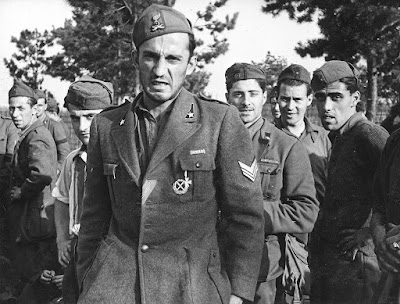
Mario Casanuova, a medical lieutenant in the 22nd Infantry Division "Cacciatori delle Alpi", thus describes in his memoirs the execution of fourteen suspected partisans from the Slovenian villages of Case, Skrjlje and Dolica Golo, rounded up during Operation "Primavera" ("Spring") on Mount Krim in July 1942: "Fourteen men were brought out of the town. They were all rather calm, poor fellows. They probably thought they would be recruited for digging work. We marched for about one kilometre, and during this time I was able to find the father of the two children and the other young man, whose documents I had taken. I returned them to him, ordering him to go back immediately, as fast as he could. They probably understood, because they darted away and were never seen again. But nobody paid attention, because everyone, officers and soldiers, had become completely brutalized. Nobody seemed resolved to do the deed, but at one point along the path we were wa...
Father Odorico Tempesta and the bombing of Foggia

Immagine
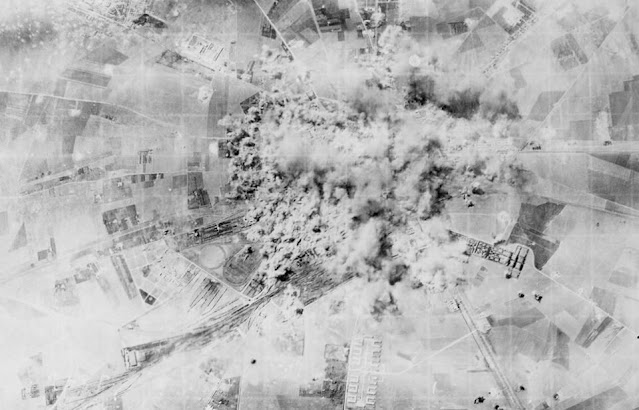
Father Odorico Tempesta, parish priest of the church of Jesus and Mary, thirty years old at the time (he died in 2003, at age 90), wrote a detailed account of the raid of 22 July 1943, one of the heaviest ones, some years after the war, using the notes he had taken back then: " After holding Mass, I went to the railway station and sent a letter to my relatives, who were worried because of what they heard about what was happening in Foggia. (…) I started the walk back to the church a few minutes after 9:30. After reaching Piazza Carmine, I heard the infamous, bloodcurling noise made by the engines of the Flying Fortresses, and immediately after that, the piercing howl of the sirens (…) I urged the people who were in the square and in front of the houses to follow me inside the church, to take shelter there. I dragged with me a trembling man, from the Gargano, he was accompanying his son to the Military District. In the so-called air raid shelter of the church, the friars from the...

Alfredo Ferri and the invasion of Sicily

Immagine
Crown Prince Umberto visits the 527th Bersaglieri Battalion in Sicily, a few weeks before the Allied invasion. Summer of 1943. The fighting near Agrigento after the Allied invasion of Sicily, in July 1943, is thus described in the recollection of Alfredo Ferri, from Treviglio (Lombardy), then a 22-year-old Bersaglieri second lieutenant: "On a bad day, towards the end of June, brief posters – almost like mourning posters – appeared on the walls of every city and small town, informing the population that it was thought that the landing of Anglo-American troops was near. In addition to the ritual demands for calm and instructions on how to behave, they informed that the bells would no longer be rung. The resuming of their sound would give the news of landing. "The days that followed were consumed, for families, in the most worried discussions about what to do and what to put away, and in the exchange of news and opinions with family and friends. The tension was becoming more acu...

Ermanno Foschi and the Italian Military Internees

Immagine
"Italian Military Internees" arrive at a German POW Camp, September 1943 (from www.ns-zwangsarbeit.de) Ermanno Foschi, from Rovereto (Trentino), was a 19-year-old recruit in the 2nd Alpine Artillery Regiment at the time of the Armistice of Cassibile. The announcement of the Armistice, on 8 September 1943, found him in the barracks in Meran, South Tyrol, where a few hours later they were rounded up by German troops who marched them to Bolzano/Bozen. After spending the night there, in the early morning of 9 September Foschi and his comrades were marched to the railway station, where a freight train was waiting for them: “ We were lined up in groups of fifty-six men in front of each wagons (…) the soldier guarding us asked “Wie viel uhr ist”, pointing to his wrist; some of my comrades, understanding that gesture, raised their arms and looked at their clocks, and at this point the soldier, aiming his submachine gun at them, ordered them to hand over their clocks. (…) We enter...